On April 19, Vercel disclosed a security incident. Attackers gained unauthorized access to internal systems, compromised a subset of customer credentials, and are now reportedly selling the stolen data for $2 million. The ShinyHunters group has claimed responsibility.
The entry point was not a misconfigured server or a phishing email sent to an engineer. The breach traced back to Context.ai, a third-party AI platform used by a Vercel employee. Attackers leveraged that compromise to access the employee’s Google Workspace account and from there, pivoted into Vercel’s internal infrastructure.
A Hudson Rock report uncovered that a Context.ai employee had been compromised with Lumma Stealer in February 2026, with harvested credentials including Google Workspace logins alongside keys for Supabase, Datadog, and Authkit. The support account for Context.ai was among the stolen records, likely enabling the attacker to escalate privileges and bypass security controls before pivoting into Vercel’s systems.
Vercel CEO Guillermo Rauch noted that the attack appeared significantly accelerated by AI, citing the attackers’ surprising speed and detailed understanding of Vercel’s systems.
What the attack chain actually looked like
This was not a direct breach. It was a supply chain escalation across three layers: a stealer infection on a Context.ai employee’s machine, credential theft that exposed OAuth tokens and service keys, and finally lateral movement into Vercel’s internal environment through a trusted integration.
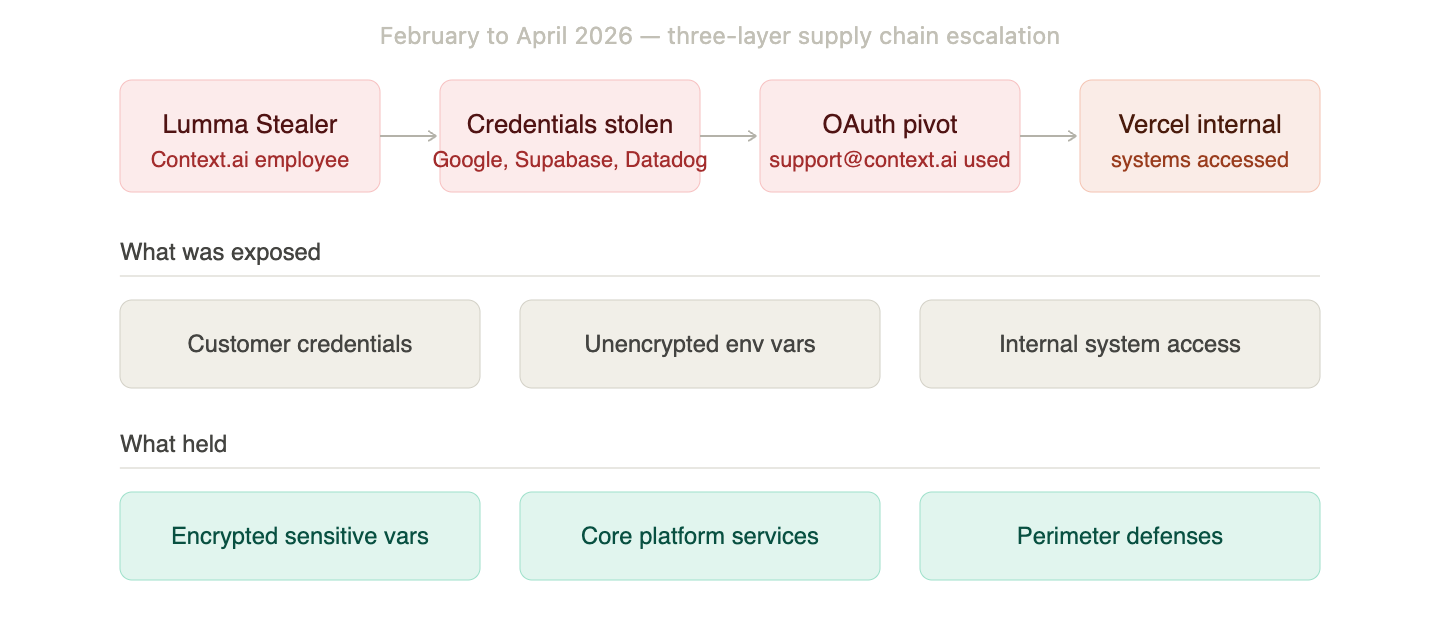
Vercel described the threat actor as “sophisticated” based on their operational velocity and detailed understanding of its systems. Attackers gained access to environment variables that users had not flagged as sensitive. Vercel’s security system encrypts data marked sensitive at rest, but variables without that designation were accessible from internal systems.
The distinction matters. The perimeter held. The encryption held, where it was applied. What failed was the assumption that a third-party AI tool integrated into internal workflows could be trusted at the level of a first-party system.
What this reveals about AI tools in production
The Vercel incident is the clearest example yet of a risk that most security teams have not fully priced in: AI tools are not passive software. They hold sessions, maintain OAuth connections, access context across services, and operate with permissions that were granted quickly, often during a trial or onboarding, and rarely reviewed afterward.
The breach, originating from a third-party AI tool rather than a direct perimeter attack, illustrates how threat actors are adapting their methods to match how modern engineering teams actually work.
Most enterprises have mature processes for evaluating new software vendors. Procurement reviews, security questionnaires, access reviews. Those processes were not designed for the current pace of AI tool adoption, where an engineer can connect a new tool to their Google Workspace in under five minutes, granting it access to email, calendar, documents, and OAuth tokens that connect downstream to everything else.
This incident fits into a well-documented escalation of supply chain compromises targeting the JavaScript and broader development ecosystem, demonstrating how attackers continue to weaponize trusted integrations.
The attack surface has changed. The governance processes have not.
The specific failure mode
This was not a failure of encryption, or of Vercel’s core security posture. It was a failure of third-party AI tool governance specifically:
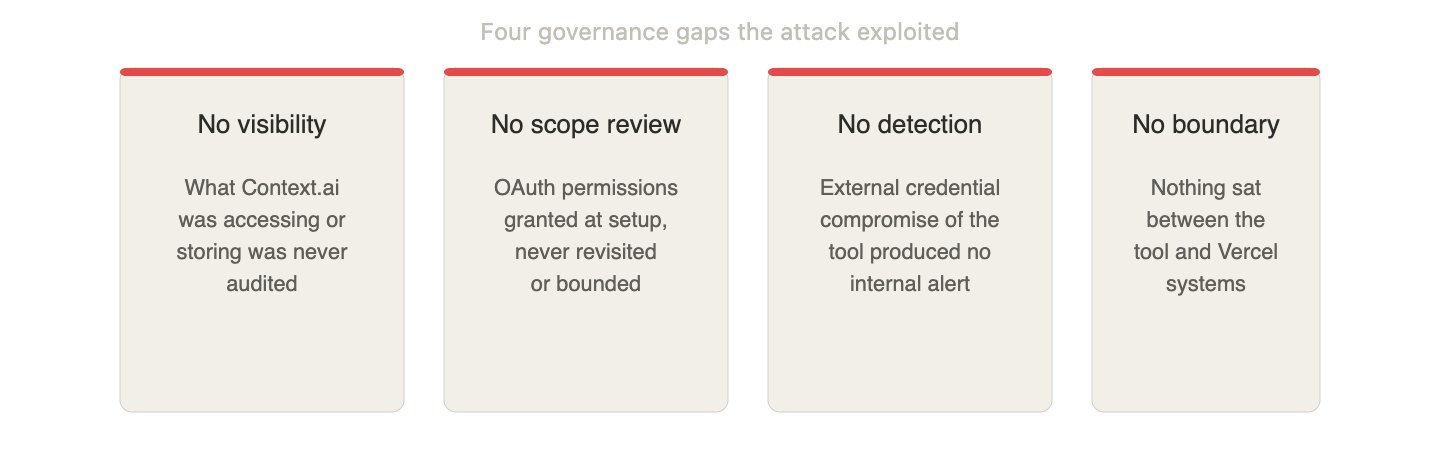
No visibility into what the tool was accessing or storing. No review of what OAuth scopes had been granted. No detection when credentials held by the tool were compromised externally. No control plane sitting between the tool’s permissions and Vercel’s internal systems.
The tool had access. The tool was compromised. Access became entry.
Why this matters beyond Vercel
Vercel’s customers include IBM, Uber, Nike, Walmart, McDonald’s, and GitHub. The company is the developer and maintainer of Next.js, with around six million weekly downloads. The downstream exposure of a breach at this layer is significant.
But the more important point is that Vercel is not unusual in how it adopted AI tooling. This pattern, an employee connects a third-party AI tool, grants broad OAuth access, the tool accumulates permissions across internal services, is the default adoption pattern at thousands of organizations right now.
The question is not whether your organization uses AI tools with access to internal systems. It almost certainly does. The question is whether those tools have defined identities, bounded permissions, and any form of runtime oversight over what they access and when.
What Xenovia is built for
The Vercel incident is precisely the scenario Xenovia’s runtime governance layer addresses. Not at the text layer, where guardrails and content filters operate, but at the action and access layer, where AI tools hold OAuth tokens, call internal APIs, and operate with permissions that were granted once and never revisited.
A runtime governance layer would have surfaced the scope of Context.ai’s access explicitly, flagged the OAuth tokens it held, and provided the audit trail needed to detect anomalous behavior before lateral movement occurred. It would not have prevented the initial stealer infection on a Context.ai employee’s machine. But it would have contained the blast radius at the boundary between that compromise and Vercel’s internal systems.
That boundary, between a third-party AI tool and the production environment it touches, is exactly where governance needs to exist and currently does not.
The pattern will repeat
This is not the last breach that will trace back to a compromised AI tool. The adoption curve is steep, the integrations are deep, and the governance infrastructure for this category of tooling has not been built yet.
Vercel disclosed quickly, engaged law enforcement, and was transparent about the attack vector. That is the right response after an incident. The harder problem is building the controls that exist before one.