A year ago, the main thing to worry about was whether your AI would hallucinate a statistic. That’s still a real problem. It’s just no longer the most dangerous one.
The more urgent issue: AI systems are no longer just generating text. They’re making calls to your production APIs, querying live databases, triggering payments, updating records in your CRM. And in most organizations, nobody has a clear answer to the question: who authorized that?
The risk has moved from output to action
The industry has spent considerable effort building guardrails around what models say: input filtering, output filtering, content policies. All of that operates at the text layer. But agents don’t operate at the text layer. They operate at the action layer, and almost none of our governance tooling has caught up.
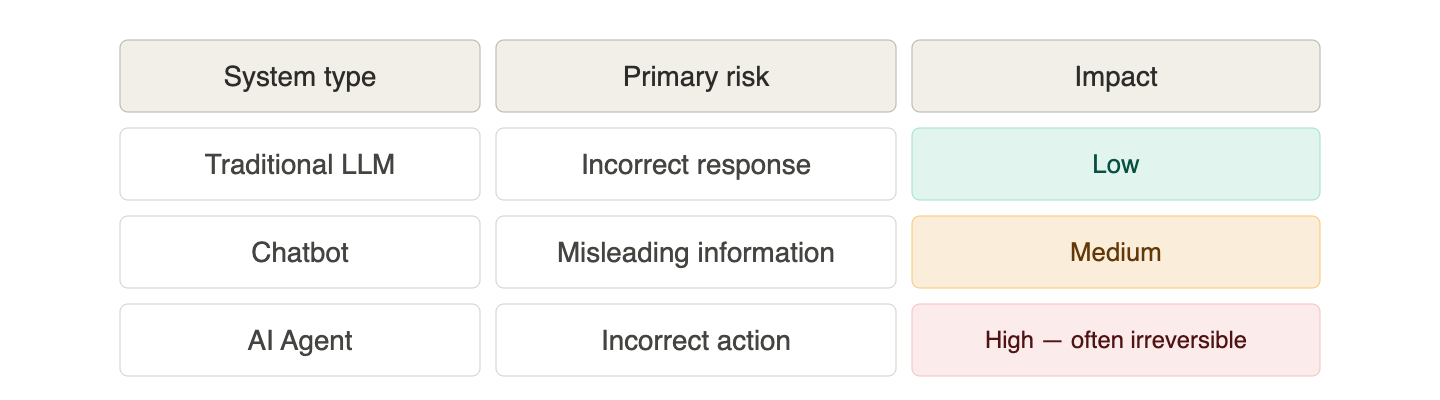
There’s a meaningful difference between a wrong answer and a wrong action. A chatbot that gives a customer bad information is a liability. An agent that sends an incorrect financial transaction, exposes customer records, or triggers an irreversible downstream workflow is a categorically different problem. The blast radius is larger. The rollback is harder. In some cases, there is no rollback.
The gap is widening
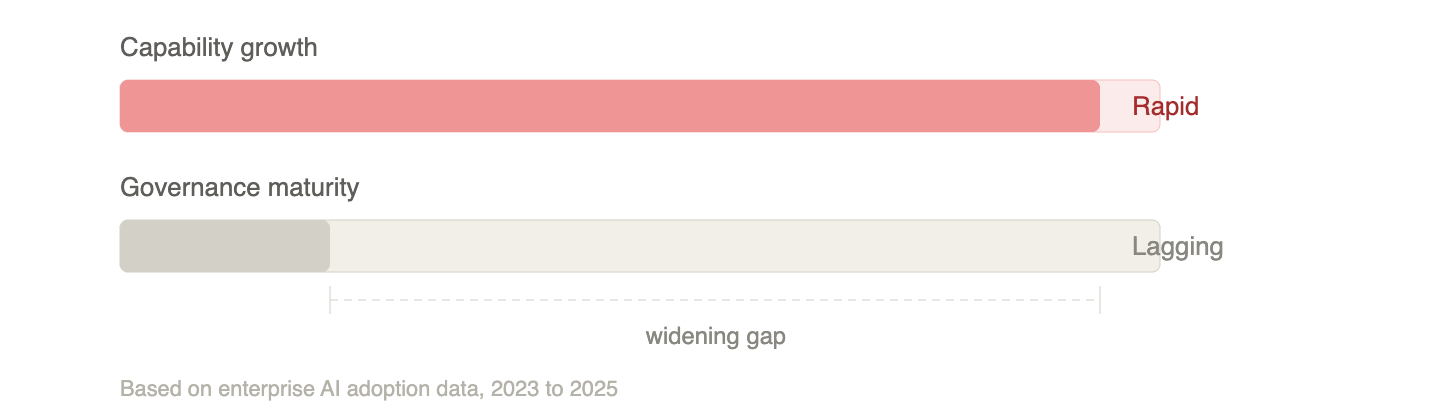
Over 60% of enterprises are now experimenting with generative AI, and agent-based architectures are increasingly the default. LLM usage has grown by orders of magnitude in under two years. The governance infrastructure hasn’t come close to keeping pace.
What’s actually running in production
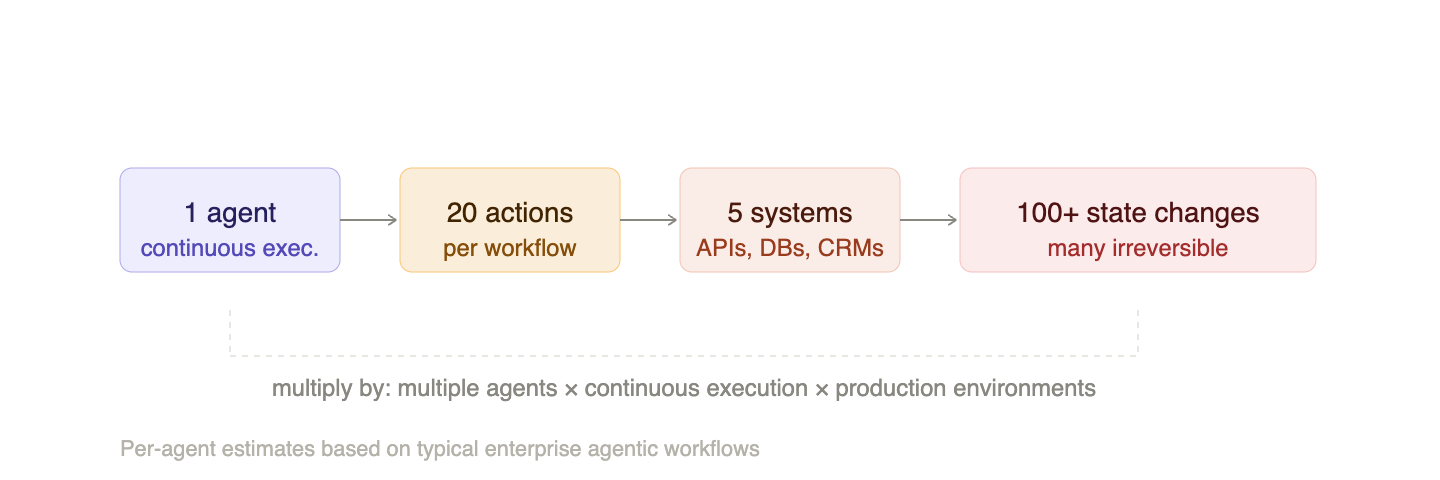
A single agent in a reasonably complex workflow might make 10–50 API calls per minute, touch 3–10 systems, and produce over 100 state changes in a single task. Now scale that across a team running agents continuously in production.
The uncomfortable reality is that most of those agents are running with broad tool access (restricting it slows demos), implicit permissions (nobody formally decided what they’re allowed to do, it just works), no defined identity (the agent acts, but there’s no auditable record of which agent, authorized by whom, acting on what), and limited observability (you can see something happened; you often can’t reconstruct why).
This isn’t a hypothetical risk posture. It’s the default configuration at most organizations experimenting with agents today.
The layer that’s missing
When software went from monoliths to distributed systems, the industry eventually built the governance infrastructure to match: IAM, policy enforcement, audit logging, observability platforms. It took time, but the gap closed.
AI is at the same inflection point, except we’re moving faster, and the control layer simply hasn’t been built yet. Guardrails answer the question “what should the model say?” They don’t answer “should this agent be allowed to call this API right now?” or “should this workflow be allowed to trigger a payment?”
Introducing Xenovia
This is the problem Xenovia is built to solve, not at the text layer, but at the action layer.
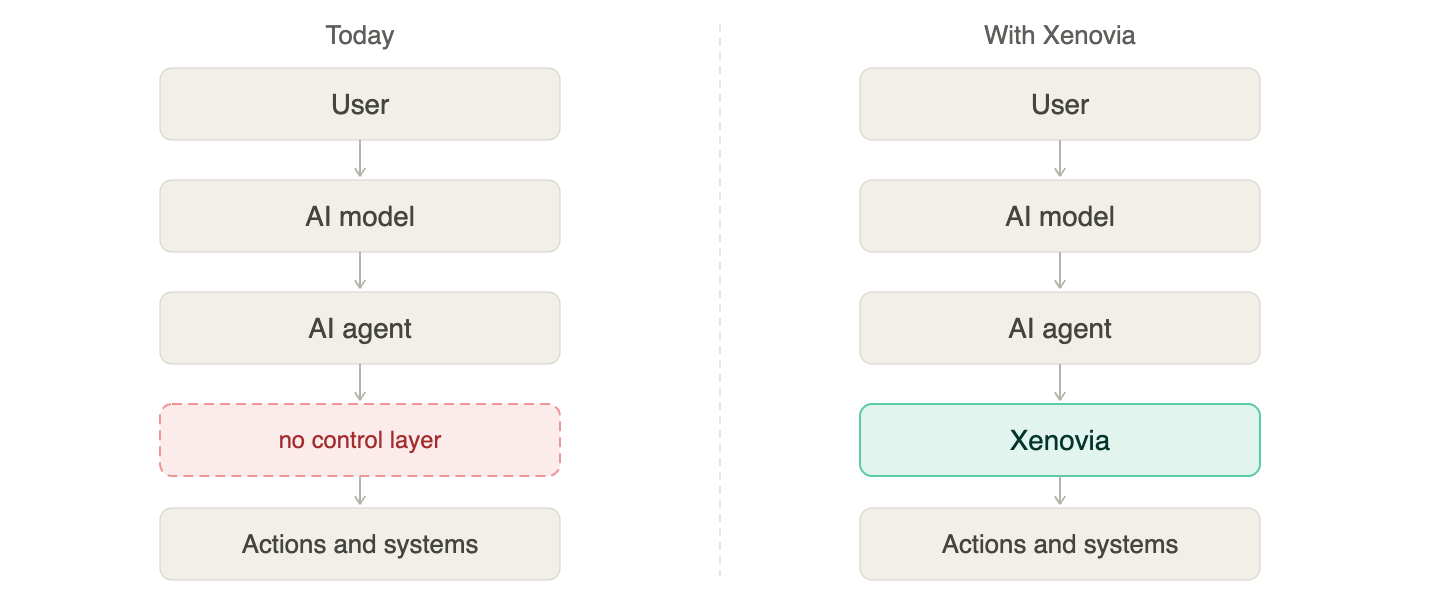
Rather than filtering model outputs after the fact, Xenovia sits between your agents and the systems they act on, enforcing policy decisions in real time. It gives agents a defined identity, assigns permissions to specific actions, classifies intent before execution, and produces a complete audit trail across every workflow. When something unexpected happens, an agent attempting an action outside its authorized scope, it can escalate to a human before the action runs rather than after the damage is done.
The goal isn’t to slow agents down. It’s to make them governable. The same way we made distributed software governable once it became powerful enough to warrant it.
We already solved this problem once. The question isn’t whether agents will take consequential actions in production, they already are. The question is whether, when something goes wrong, you’ll have any idea what happened. And whether you had any mechanism to prevent it.